















Description
Saint-Étienne-de-Lugdarès, at an altitude of 1 m, reveals its unspoiled nature, the Mountain Cathedral, its former lords, the Beast of Gévaudan and Henri Charrière, alias Papillon. Here, history intersects with legend at every step.
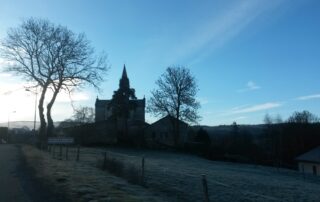
The heart of the village beats around its impressive 1302th-century church, aptly nicknamed the Mountain Cathedral. Built of granite and polychrome volcanic stone, it retains a majestic Baroque high altar, originating from the former Chambons Abbey. Although remodeled, the church retains Gothic elements and its origins date back to XNUMX.
On the northern slope, in the enclosed valley, lies the hamlet of Hubacs (or Ubas), a place steeped in history and legend. It was here that the mysterious Beast of Gévaudan claimed its very first victim: Jeanne Boulet, on June 30, 1764.
But the history of the Hubacs goes back much further. There are traces of an ancient medieval lordship, established as early as the 12th century, and attached to the Agrain d'Ubas family, descended by marriage from the Solignac family, a great lineage of Velay. The Hubacs castle, now disappeared, witnessed several notable events, including the famous Battle of the Three Lords.
In 1324, while 2 English soldiers were besieging the Château de Luc, three lords united by the co-barony—Polignac, Bourbal de Choisinet, and d'Agrain des Hubacs—countered. On the Hubacs' lands, a fierce battle ensued. Outnumbered, they were on the verge of surrendering when they were rescued by ten gentlemen from the surrounding area. Thanks to this reinforcement, they won a total victory.
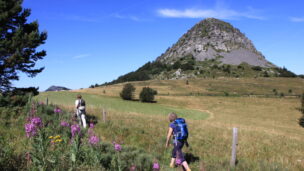
In memory of this act of bravery, the three lords had their coats of arms engraved on three large granite stones, still visible at the summit of the Prasoncoupe-les-Ubas volcano, at the place now called "The Summit of the Three Lords". This site, steeped in history, is accessible on foot, for hiking enthusiasts.
The Ubas lordship lasted until December 19, 1830, the date of the death of the last heir, Charles-Hippolyte-Gustave d'Agrain, aged 22. He died a victim of his devotion to the inhabitants of Hubacs, who had contracted typhoid fever. Like him, this aristocratic lineage was able to combine nobility of spirit and a sense of duty, as chronicles of the time attest.
Personalities linked to the village
Henri Charrière, known as Papillon, famous for his escape from the Cayenne penal colony and immortalized in the novel and film of the same name, was born in Saint-Étienne-de-Lugdarès. A museum is dedicated to him.
Cardinal Joseph-Christian-Ernest Bourret, Bishop of Rodez, also comes from this Ardèche region.
The Congregation of the Sisters of Saint Joseph founded the Saint Joseph Convent in Saint-Étienne-de-Lugdarès. Today, this large convent houses the administrative offices of the town.
The Watershed is a hiking trail, dotted with contemporary works of art, showcasing the natural and cultural heritage of the Ardèche Mountains. This trail follows the invisible border between the Mediterranean and Atlantic watersheds.
At Suc de Montat, you will discover the Mires, artistic installations which offer an original immersion in the landscape, allowing you to better understand the watershed.
Accessible on foot from the D239, between Le Bez and Croix de Bauzon. Access is signposted. Les Mires are located on the Suc de Montat, which also houses an electrical relay (antenna visible from a distance), on the slope opposite the Col du Pendu.
The commune of Saint Etienne de Lugdarès covers nearly 5 hectares.
Opening
All year round, every day.
We also offer:



Prices
| Free access. |
Localisation